
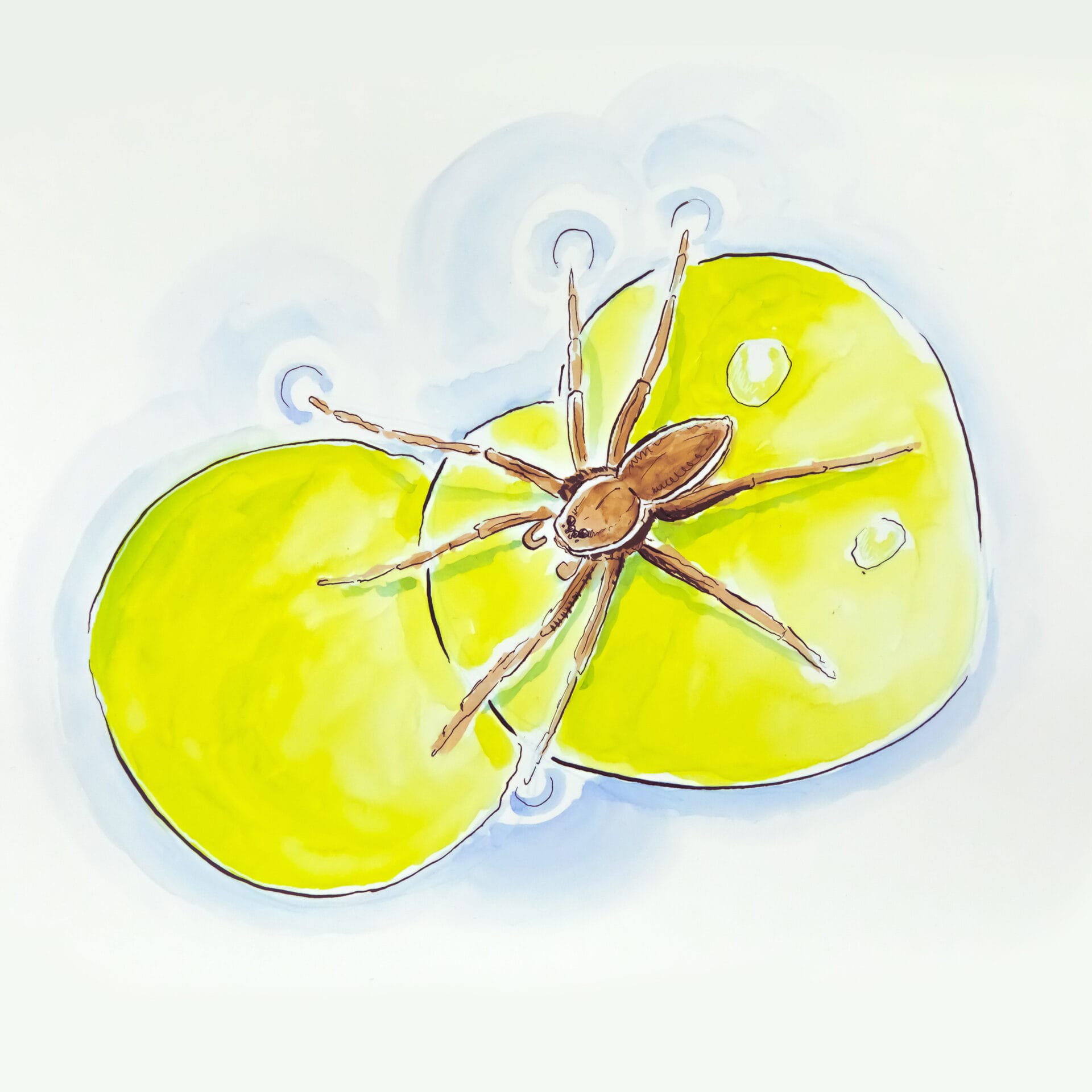
Fen Raft Spider
Dolomedes plantarius
Various
The largest native spider found in the UK, the fen raft spider’s numbers are under serious threat due to habitat loss. However, conservation efforts are helping to reverse this fortune. Using genomics to study this species will help ensure genetic fitness in the species, and overcoming population bottlenecks that have emerged because of reduced options for breeding. It will also reveal more about its semi-aquatic lifestyle, making it a useful bridge between land and water-based spiders.

It’s in the genes
The majority of fen raft spiders have distinctive white bands along their bodies, like a go-faster stripe. This feature is genetic, meaning the genes a spider inherits from its parents determine whether it will have the stripe, or not. The stripe is a dominant gene (S) and the non-stripe is recessive (s). We inherit half of our genes from our mother and the other half from our father. If a spider inherits an S then it will have the stripe.

On the Margins: The Fen Raft Spiders of Redgrove and Lopham Fen
Dr Helen Smith and Sheila Tilmouth
The fen raft spider was identified at Redgrave and Lopham Fen in 1958. Four years later, a borehole was sunk in the fen, removing 3,500 tonnes of water each day. Over decades this dramatically changed the spider’s habitat, critically reducing its numbers. On the Margins is a tribute to this rare and unusual spider, whose status as an endangered species is improving through conservation and closer study.
 Back to top