
Feb 27 2026
Focus on our suppliers: Saffron Grange
Located just four miles distance from Hinxton Hall, Saffron Grange vineyard is our closest supplier to date!
In 2025, Saffron Grange – a relatively-new, family-run vineyard specialising in sparkling wines – started supplying Hinxton Hall with their Sparkling Rosé and Classic Cuvée.

A labour of love
Saffron Grange is very much a labour of love. It took owner, Paul Edwards, and his team – made up of family members and experts – eleven years to plan, plant, and nurture the vineyard before opening to the public in 2019. Paul had spent decades working in the food and drinks industry abroad, before returning to Essex, the county of his childhood, to search for the perfect location for his new project.
Paul describes the venture as ‘his personal mission to inspire both his family and the wider local community to create a new wine landscape and business opportunity for the Saffron region and leave a legacy for many years to come.’

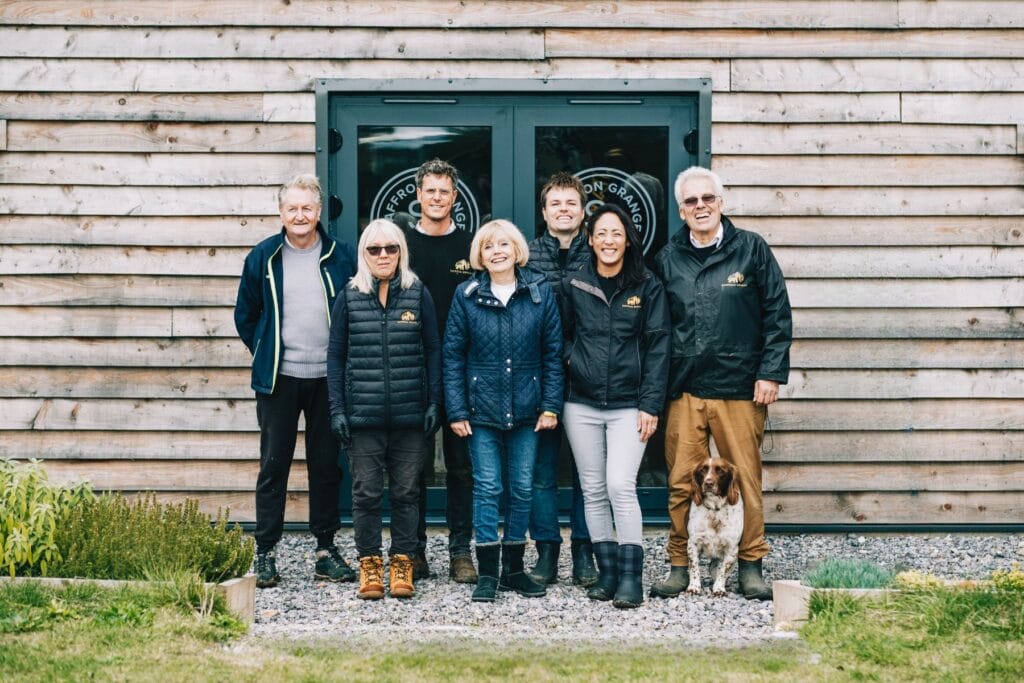
Paul’s wife, Ross, son, Nick, and daughter-in-law, Aimie, are core team members, along with Vineyard Manager, Paul Harrison, and vineyard assistant Sophie. They work closely with international experts to make the wines each year, and have a growing team both in the Vineyard as well in their front of house. Importantly, there is a 50/50 ratio of women to men in the team, which they are proud of in an industry that is fairly male dominated.
Saffron Grange also benefits from teams of local volunteers that join them in the summer months to help with leaf plucking (to improve air flow, sun exposure, temperature regulation) and then – of course – harvesting.
The venue itself comprises a vineyard and a winery, with a shop with bar for tasting experiences. They run tours and tastings throughout the year, and during the summer months they hold weekly Sundowner events outdoors for anyone to come any enjoy the wines and countryside in good company. You can find out about these events by following them on Instagram, or signing up to their newsletter.

The vineyard and regenerative viticulture
The Saffron Grange team strongly believe in working with the land, rather than simply using it, and that this is one of the keys to the success of their wines. They work hard to protect the land and wildlife by practicing regenerative viticulture, improving soil health and encouraging a thriving, biodiverse ecosystem.

Here are some of their initiatives:
- No herbicides or insecticides
- Wildflower margins to boost biodiversity
- Regenerative practices to nurture soil health
- Minimal intervention vineyard practices
- Actively encourage predatory insects such as earwigs, ladybirds, hoverflies and wasps, which help to naturally control aphids which can impact vine growth
- Encouraging birds, insects and other wildlife to thrive through careful land design and how it’s managed
- Mulching vine prunings back into the soil and using worm tea to enrich the soil life
- Using sheep to graze around the vines in winter, reducing the need to bring in machinery, and enjoying the benefits of their dropping, which is an excellent, natural fertiliser
- Incorporating more diverse grasses and bird seed mixes into the ground cover to further support bird life
- By 2025 they had planted over 8000 trees on site with more planned for the future, both to provide shelter to the vines but also add to wildlife corridors

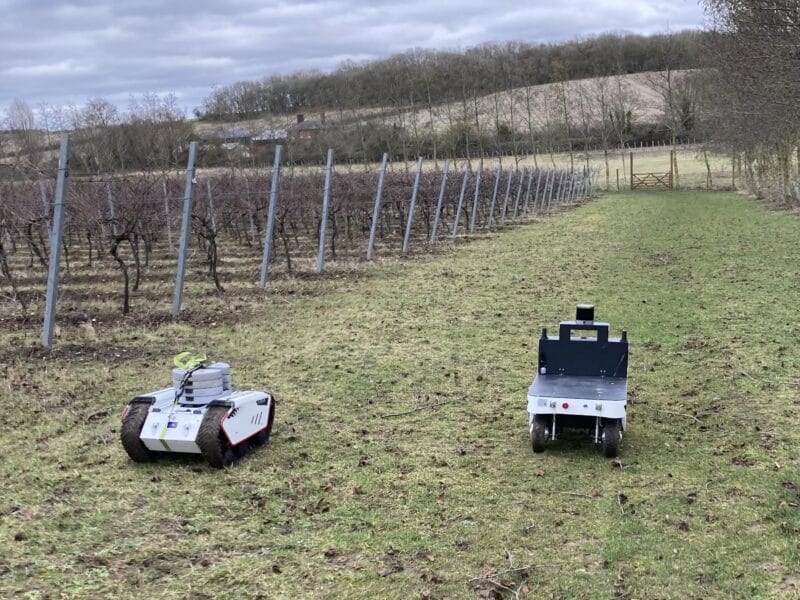 Over the past couple of years, Saffron Grange has also been the pilot vineyard for an exciting ‘precision viticulture’ project, in partnership with Queen Mary University and Extend Robotics, aimed at making vineyard management practices more efficient. Precision viticulture blends advanced technologies, data analytics, and precision farming techniques to allow growers to remotely monitor crop health, identify potential issues early on, and take appropriate action. The test robot is operated remotely through a VR headset, and uses image spectral analysis to analyse the grapes, before they are then carefully machine picked. The project hopes to further develop this prototype to analyse vine health by helping to quickly and effectively detect pests and diseases. So they are looking forward to a time when a robot can join the Saffron Grange Vineyard team!
The grapes and the wine-making process
Saffron Grange works with five grape varieties – Chardonnay, Pinot Noir, Pinot Meunier, Seyval Blanc, and Pinot Gris – to create their delicious sparkling wines, and use what is called ‘the traditional method’ – more popularly known as the ‘Champagne method’ or ‘méthode Champenoise’.
After the grapes have been hand-picked and gently pressed, the grape juice undergoes two rounds of fermentation, the second of which takes place in the bottle. For the secondary fermentation, they add yeast, nutrients and sugar (tirage) to the base wine and this naturally produces carbon dioxide and results in a sparkling wine.
The wines are then stored on the lees (the sediment that remains in the bottle) usually for two to three years to give more depth to the taste and mature the wine.
After the lees are removed, the final stage of the process is called ‘dosage’ where the ultimate style of the sparkling wine is chosen. This involves the addition of specific amounts of sugar, ranging from zero dosage (none), brut (6-12g/l), extra dry (12g-18g/l) or up to the sweetest style, ‘doux’ – a huge 50+g/l! The controlled addition of dosage liqueur (sugar blended with the same wine from the bottle) directly into the bottle before corking is critical to ensure that the wine can continue to develop further character and balance from ageing.
All the Saffron Grange wines are vegan as they made a conscious decision to avoid bringing animal products into the wine-making process. Traditionally, wine producers used fining agents - made from things like milk protein, egg whites, gelatine or fish bladder protein - to draw out the molecules in wines that gave it a hazy appearance. Instead, Saffron Grange wine makers removed the need for traditional fining agents completely by instead passing the wine through a cross-flow filter system to remove the haze-inducing molecules.

The Saffron Grange wines served at Hinxton Hall
2022 Classic Cuvée
The Classic Cuvée is their signature style and the one which has accrued the most number of awards for them over the years and what they consider to consistently showcase the Saffron Grange style; fruit-forward, clean with a hint of toast, great minerality and lovely acidity; a sparkling wine with finesse!
The 2022 vintage will be remembered for its warmth and consistency, with a relatively frost-free spring followed by dry, settled conditions throughout the growing season. The summer culminated in the hottest day ever recorded in the UK on 19th July, reaching 38.5°C, leading to beautifully ripe fruit and an earlier-than-usual harvest at the beginning of October.
The wine presents aromas of plums and quince on the nose perfectly balanced with apricot, pastry, and their signature flint minerality on the finish. And it pairs perfectly with grilled chicken, scallops, or creamy risotto dishes.
2022 Classic Cuvée Wine Statistics
- Grapes: 50% Pinot Noir, 35% Chardonnay, 15% Pinot Meunier
- PDO – English Quality Sparkling Wine
- Bottled: July 2023
- Lees ageing: Minimum of 30 months
- Titratable Acidity: 10.2 g/l
- pH: 2.9
- Total sugars: 7g/l (Brut)
- Alcohol: 12.5%
- Harvest period: Early October 2020
2023 Sparkling Rosé
Following on from the hugely popular 2022 Sparkling Rosé, Saffron grange say they couldn’t be happier to move onto this wine, produced from their largest ever harvest and only using first pressings (the best quality juice) for the first time in our sparkling rosé.
The nose has a bouquet of red apples, cranberries and peaches leading to pomegranate, pear and creamy lemon curd on the finish. This food-friendly wine can be enjoyed with seared tuna or a peach and burrata salad.
2023 Sparkling Rosé Wine Statistics
- Grapes: 65% Pinot Noir, 35% Chardonnay
- PDO – English Quality Sparkling Wine
- Bottled: June 2024
- Lees ageing: Minimum of 19 months
- Titratable acidity: 8 g/l
- pH: 2.78
- Total sugars: 8g/l (Brut)
- Alcohol: 12.3%
- Harvest period: Mid to late October 2023
We hope that learning more about Saffron Grange and its wines has given you an irresistible urge to try them! You can enjoy these delicious wines either with your meal at Hinxton Hall, by visiting Saffron Grange winery, buying from them online, or in local shops.

Before you go, did you know that...?
Originally, champagne was produced with high levels of added sugar to create a sweet dessert wine with limited bubbles, but by the 1800’s wine merchants began asking the French houses to produce a lighter, dryer style of Champagne for the English market?
And that…?
Some parts of East Anglia – including the Saffron Grange vineyard in North West Essex – sit on the same mineral-rich chalk seam that runs through the famous wine regions of Northern France? This is favourable because vines growing on chalk tend to stretch their roots deep into the soil, giving a complexity and minerality to the grape’s final flavour. Combined with the area’s gently sloping hills, and cool, dry climate and warmer summers, it creates the perfect conditions for growing grapes for truly premium quality sparkling wines.
If you want to learn more about the life at a vineyard, check out these fascinating articles on the Saffron Grange website, explaining
- what happens during the winter months whilst the vines are dormant
- all about winter pruning
- what processes happen in the vines between pruning and flowering
and more!
 Back to top